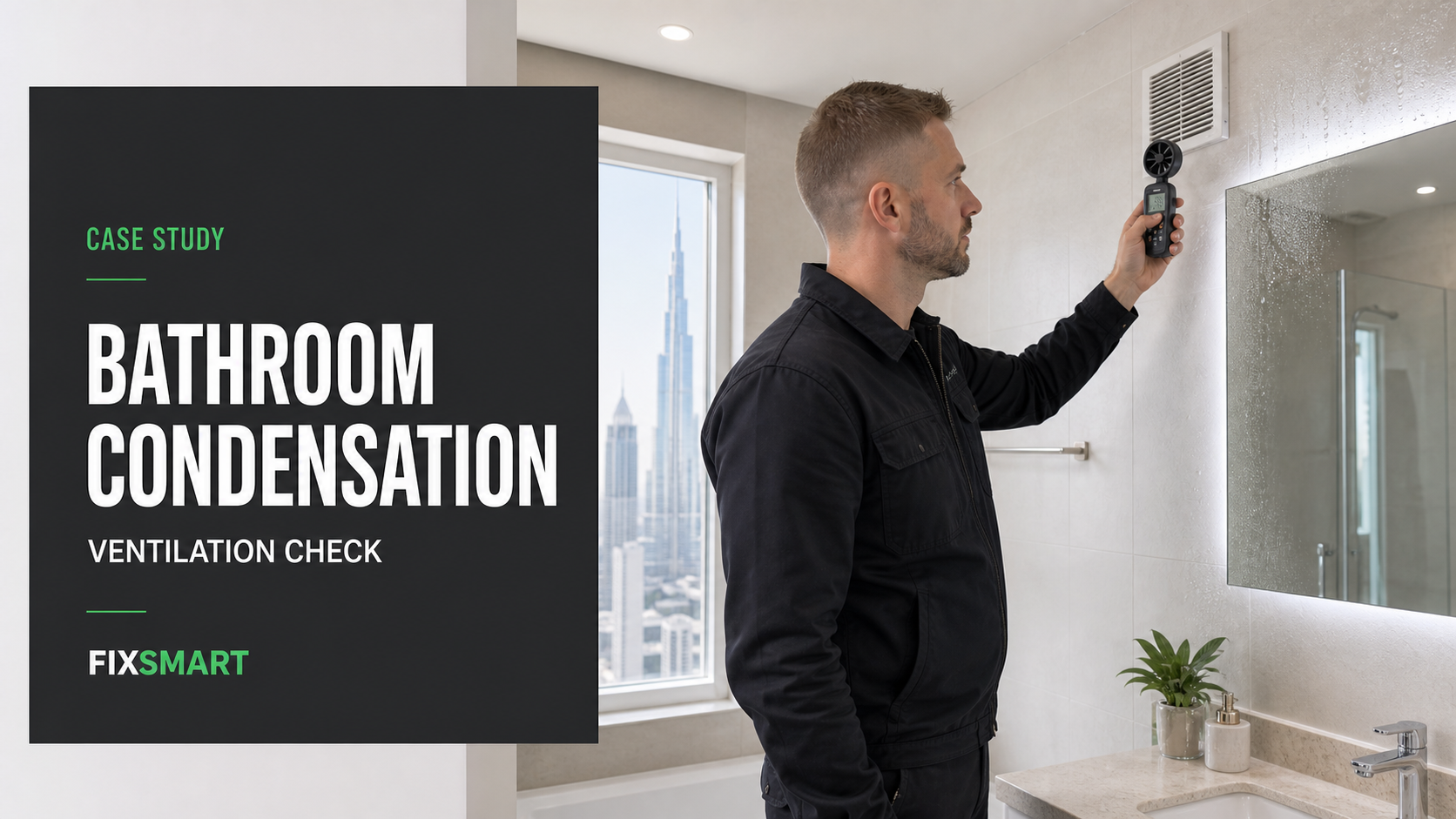
Persistent bathroom condensation in Dubai should be treated as a moisture-source problem, not only a surface-cleaning task. Note when the water appears, test whether extraction and airflow are working, and check for signs of an active plumbing, AC condensate, waterproofing or upstairs leak. Bulging finishes, water near electrical equipment or continuous dripping require prompt professional assessment.
An illustrative Dubai apartment case
This is an educational diagnostic scenario, not a claim about a verified FixSmart customer. In a one-bedroom Dubai apartment, the mirror and upper walls stayed wet long after showers. Dark spotting returned near a ceiling corner even after cleaning, and a faint musty odour was strongest when the bathroom door remained closed.
The first assumption was a pipe leak from the apartment above. A timeline changed the investigation: the marks became visibly wetter after showers, improved when the door stayed open and were not actively dripping during long periods without bathroom use. The exhaust grille made noise, but a tissue held near it showed weak pull.
That pattern did not prove the final cause, but it moved ventilation and airflow higher on the list while keeping concealed leakage as an open possibility. A useful diagnosis narrows causes with evidence instead of replacing parts based on one symptom.
Why timing matters
Record the moisture before a shower, immediately afterward, 30 minutes later and several hours later. Note whether it appears only on cold surfaces, along a pipe route, below an AC duct, around a silicone joint or in one ceiling patch.
Condensation often follows a humidity event and forms across mirrors, tiles, ceilings or cold pipe surfaces. An active plumbing leak may continue when nobody has showered. An AC condensate issue can correlate with cooling operation rather than water use. Waterproofing or an upstairs leak may produce a persistent localised patch. These are clues, not remote proof.
The Dubai AC water-leak case shows why water location alone does not identify the source. A drain restriction, insulation issue and supply leak require different repairs.
Check ventilation without opening electrical equipment
Turn on the bathroom extractor and listen for normal operation. Hold a light piece of tissue near the grille without pushing it into the fan. Weak pull can result from a dirty grille, failed fan, disconnected or restricted duct, closed damper, poor replacement-air path or a wider ventilation-system issue. Noise alone does not confirm useful airflow.
Check whether the bathroom door has an intended transfer-air gap or grille and whether it has been blocked by a new threshold, mat or door adjustment. An extractor cannot move much air out if replacement air cannot enter. Do not cut the door or alter a fire-rated component without approval.
Do not remove the fan cover, touch wiring or work from an improvised platform. Water and electricity make this an unsuitable area for guesswork. If access is above normal reach, follow the home ladder safety checklist.
Humidity and Dubai indoor-air guidance
Dubai Municipality's indoor-air-quality guidance gives a 30 to 60 percent relative-humidity range for occupied, air-conditioned spaces for most of the year and emphasises suitable ventilation and HVAC inspection. A small consumer humidity meter can help reveal patterns, but it does not replace calibrated testing or a ventilation assessment.
The US Environmental Protection Agency gives the same practical principle: moisture control is the key to mould control. It recommends drying wet areas promptly, reducing the water source and using bathroom ventilation. Cleaning visible spotting without correcting the moisture condition commonly allows the problem to return.
Keep the AC and ventilation strategy consistent with the building's design. Leaving external windows open in hot, humid weather can introduce more moisture into an air-conditioned space. A professional should consider indoor and outdoor conditions, extraction, replacement air and the central HVAC arrangement together.
For routine cooling maintenance context, see the Dubai AC filter cleaning guide. A clean filter supports normal system operation, but it is not a universal fix for bathroom condensation.
Separate five possible causes
1. Normal short-duration shower condensation
Moisture appears on cool surfaces during or immediately after a shower and clears as extraction and air movement continue. The practical focus is shower duration, extraction time, airflow path and drying.
2. Weak or failed extraction
The fan may be silent, unusually noisy or running without meaningful airflow. The grille, fan, duct route, damper and discharge point may require inspection. A replacement fan should be selected for the actual system, not only by faceplate size.
3. Plumbing leakage
A local patch may remain wet independently of showers in the room. Supply lines, waste connections, mixer penetrations and fixtures in the apartment above may need coordinated testing. Avoid opening ceilings until the access, protection and reinstatement plan is agreed.
4. AC condensate or cold-surface condensation
Moisture may track from a condensate line, duct or poorly insulated cold surface. The pattern can change with AC operation. An AC technician may need to check drainage, insulation and nearby air distribution.
5. Waterproofing or seal failure
Water may move through failed joints, penetrations or waterproofing during shower use. Surface silicone replacement is not a complete waterproofing diagnosis. The provider should identify the test boundary and explain what result would justify opening finishes.
What the professional assessment should record
A useful visit begins with the timeline, locations and building context. Ask the provider to document visible moisture patterns, extractor operation, accessible grille condition, airflow observations, humidity readings where relevant, likely source categories and any follow-up test.
The quotation should separate ventilation cleaning or repair from plumbing, AC, waterproofing, mould remediation and decorative reinstatement. These are different scopes. Use the guide on choosing a home-service professional in Dubai to confirm experience, documentation, exclusions, testing and warranty.
When visible growth is extensive, repeatedly returns, affects porous material, follows major water damage or may involve the HVAC system, ask for an appropriate moisture and remediation assessment. Do not paint over an unresolved damp surface.
Rental and building-management coordination
Notify the landlord or property manager with dated photos, the moisture timeline and affected rooms. If the suspected source is above the ceiling, in a common duct or from another apartment, building management may need to coordinate access.
The Dubai rental maintenance responsibility guide helps organise notice and approvals. If the issue was visible at handover, compare it with the Dubai apartment move-in inspection checklist and your dated condition report.
Post a diagnostic task through FixSmart
FixSmart is a Dubai service marketplace, not the company performing ventilation, plumbing, AC or remediation work. Create a task on the FixSmart homepage with the property type, Dubai community, moisture locations, timing, shower and AC relationship, extractor behaviour, odour, previous repairs and safe photos.
Ask responding professionals which cause they intend to test first, what access is included and how findings will be documented before extra work. The selected provider remains responsible for diagnosis, work, invoice and warranty.
Frequently asked questions
Is bathroom condensation always a ventilation problem?
No. Ventilation is common, but plumbing, AC condensate, insulation, waterproofing and upstairs leakage can produce similar visible moisture.
Does a noisy extractor fan mean it is working?
Not necessarily. The motor can run while airflow is weak because of a dirty grille, restriction, duct issue or inadequate replacement air.
Should I leave the bathroom window open in Dubai?
Not automatically. Hot humid outdoor air can add moisture to an air-conditioned property. Follow the building's ventilation design and obtain professional advice for persistent problems.
Can I solve recurring spotting by repainting?
Not while the moisture source remains. The surface must be dry, the cause corrected and any damaged material assessed before refinishing.
When is the problem urgent?
Treat active dripping, a bulging ceiling, rapidly spreading damage, contaminated wastewater or moisture near lights, fans and wiring as urgent. Keep clear and arrange appropriate help.
Sources and review date
Reviewed on 1 September 2026 against Dubai Municipality indoor-air-quality and ventilation guidance, Dubai Municipality's mould-control guideline index and US EPA residential moisture-control guidance. This illustrative case supports task preparation and does not replace an on-site diagnosis.